Porcelain paving
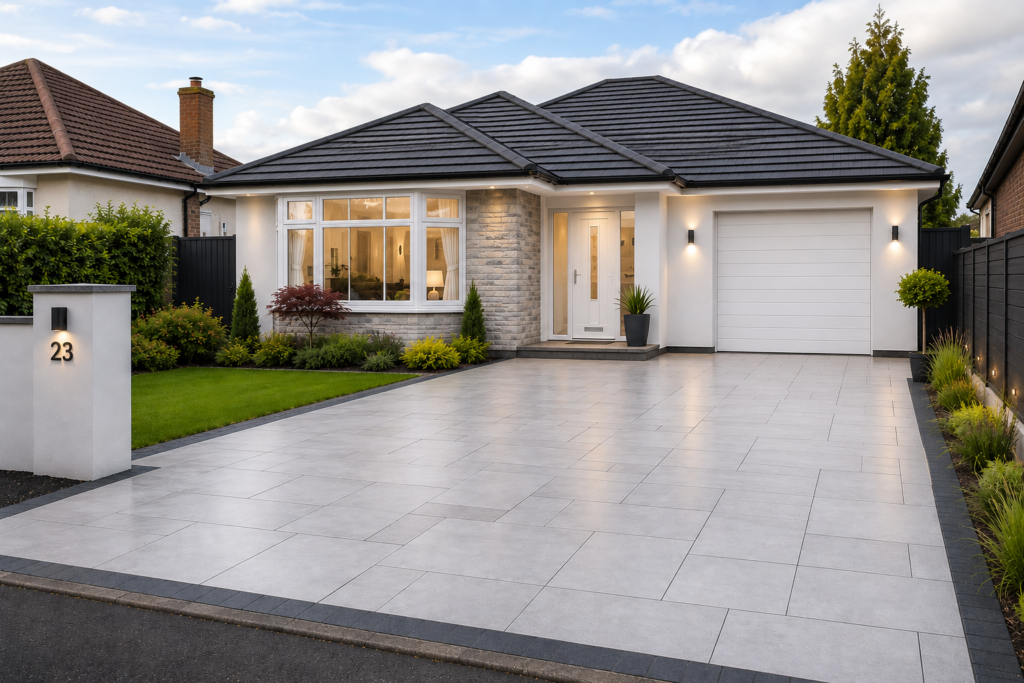
Porcelain can create a clean contemporary driveway, but only products specifically rated for vehicle loading should be considered. The slab thickness, bed, bonding, joints, drainage and edge support must form a complete driveway system.
- Consistent colour and precise modern detailing
- Low water absorption and straightforward cleaning
- Requires driveway-rated slabs and careful full-bed installation
- Poor bedding or unsupported edges can lead to movement or breakage
Choosing a suitable product
Confirm that the manufacturer approves the exact slab for domestic vehicle use. Patio-rated porcelain should not automatically be treated as a driveway product.
Base and bedding
The sub-base and rigid laying bed must be designed for vehicle loading. Full contact beneath each slab and an appropriate bonding slurry are important because porcelain has very low water absorption.
Joints, cuts and edges
Joint widths, movement provision, edge restraint and neat cuts around covers or curves should be agreed in advance. Exposed or poorly supported edges are vulnerable to damage.
Grip and drainage
Choose an external slip-resistant finish and consider how grip changes when wet. Falls and channels must prevent water collecting on large-format slabs or flowing towards the property.
Cleaning and repairs
Porcelain generally resists staining, but suitable cleaning products should be used. Keep spare slabs from the same batch because later colour or format matching may be difficult.
Questions for the quotation
- Is the exact slab manufacturer-rated for driveways?
- What slab thickness, bed and bonding system are included?
- How are movement joints and edges handled?
- What wet slip rating applies?
- Are spare matching slabs included for future repairs?
Porcelain paving cost scenarios
These worked examples use the current porcelain paving rate of £110 per m² and the same preparation and fixed-cost allowances used by the estimator. They are illustrative ranges, not contractor quotations.
Small single-car driveway
25m² · Minor local base preparation, straightforward access and no additional drainage work.
Standard two-car replacement
50m² · Existing tarmac removed, normal access, waste taken away and a drainage allowance included.
Large and more complex installation
80m² · Existing concrete removed, restricted access, waste and drainage allowances, plus a gentle slope.
Actual quotations can change after a site survey, specification choice, regional labour and supplier pricing, drainage design and ground-condition checks.
Peace of Mind from Estimate to Completion
Your Peace of Mind Project Tracker keeps the important stages, updates, photographs, documents and payments together, helping you understand what has happened and what comes next.
The material guide helps with the early decision. The accepted installer quotation and project specification remain the documents that define the work.
Estimate a porcelain paving driveway
Enter the property, approximate area, existing surface and access details to receive an indicative price range.
Start an estimateCompare driveway costs