Pattern-imprinted concrete
Pattern-imprinted concrete is a continuous concrete slab that is coloured and stamped before curing to resemble stone, cobbles, slate or block paving. It creates a bold decorative finish with no sand-filled joints, but successful installation depends on planning the pour, drainage and control joints carefully.
- Continuous decorative slab with many colours and patterns
- No individual paving joints for weeds to colonise
- Control joints and drainage must be planned before pouring
- Periodic cleaning and resealing are usually required
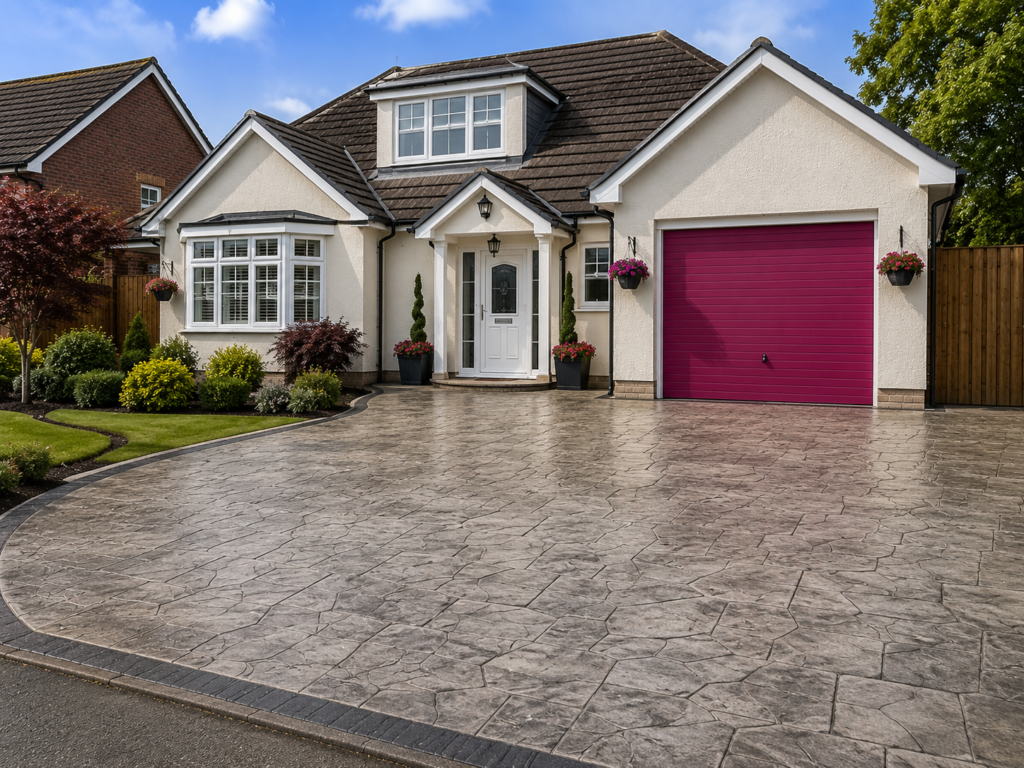
What patterned concrete is
The driveway is formed as a concrete slab. Colour hardener is applied to the surface, release powder prevents the imprint mats from sticking, and textured mats are pressed into the concrete before it sets.
After curing and cleaning, the surface is normally sealed. The result can imitate paving or natural stone, but it remains a single concrete slab with planned joints rather than individual units.
Where it works well
Patterned concrete suits properties that want a decorative, low-joint surface and a consistent colour scheme across driveways, paths and patios. It can form sweeping curves and detailed borders without laying thousands of individual blocks.
Future access to buried services and invisible local repairs are more difficult than with block paving. Owners should consider repairability as well as the initial appearance.
What affects the price
Area, excavation, concrete specification, reinforcement strategy, pattern, colour, border detail, drainage, access and sealing affect the total. Small irregular sites require more hand work and careful timing during the pour.
Multiple colours, contrasting borders and complex patterns increase labour. Concrete-pump access or long-distance barrowing can also change the price where a delivery vehicle cannot approach the site.
Base, slab and reinforcement
The ground and sub-base are prepared before concrete is placed. The required slab thickness and reinforcement approach depend on site conditions, loading and the contractor system.
Levels, drainage, manhole details and joints must be agreed before the pour begins because changes are difficult once the concrete is placed. A rushed or poorly coordinated pour can produce colour, pattern and level inconsistencies.
Control joints and cracking
Concrete shrinks as it cures and can move with temperature and ground conditions. Control joints are deliberately positioned to encourage movement along planned lines.
No responsible installer should guarantee that concrete will never crack. Ask where joints will be located, how they will be cut or formed and how unavoidable cracking is handled under the workmanship guarantee.
Drainage and surface grip
Patterned concrete is generally impermeable, so falls and drainage channels must direct rainwater to a suitable destination. Thresholds and pavement boundaries require particular care.
The pattern and sealer influence surface texture. Anti-slip additive may be used in the sealer, especially on sloping drives, steps and shaded areas. Ask how grip will be maintained after future resealing.
Colours, patterns and appearance
Common patterns imitate cobbles, slate, ashlar stone and block paving. Colour hardeners and release agents combine to produce the final tone, which can differ from brochures and small samples.
View several completed driveways in natural light and ask how the colour changes after sealing and weathering. The skill of the installation team affects pattern alignment, edge detail and consistency.
Maintenance and resealing
The surface should be cleaned without damaging the sealer, and oil or chemical spills should be treated promptly. Resealing is normally required periodically to refresh colour and protect the surface.
Incorrect preparation, excessive sealer or unsuitable weather can create whitening, patchiness or a slippery finish. The quotation should explain the initial seal, future resealing interval and whether maintenance is included.
Repairs and common problems
Cracks, settlement, drainage faults and damaged sections are harder to repair invisibly than individual paving blocks. Matching the original colour and pattern can be difficult after weathering.
Common complaints include poorly placed joints, standing water, flaking sealer, inconsistent colour and pattern distortion. Detailed specification and examples of recent completed work are especially important.
Questions for the quotation
- What concrete specification, slab depth and reinforcement are included?
- Where will control joints be placed and how will they be finished?
- Which pattern, colour hardener, release agent and sealer are specified?
- How will drainage and slip resistance be managed?
- When will the driveway be safe for foot and vehicle traffic?
- What maintenance, resealing and cracking terms are included?
Pattern-imprinted concrete cost scenarios
These worked examples use the current pattern-imprinted concrete rate of £65 per m² and the same preparation and fixed-cost allowances used by the estimator. They are illustrative ranges, not contractor quotations.
Small single-car driveway
25m² · Minor local base preparation, straightforward access and no additional drainage work.
Standard two-car replacement
50m² · Existing tarmac removed, normal access, waste taken away and a drainage allowance included.
Large and more complex installation
80m² · Existing concrete removed, restricted access, waste and drainage allowances, plus a gentle slope.
Actual quotations can change after a site survey, specification choice, regional labour and supplier pricing, drainage design and ground-condition checks.
Peace of Mind from Estimate to Completion
Your Peace of Mind Project Tracker keeps the important stages, updates, photographs, documents and payments together, helping you understand what has happened and what comes next.
The material guide helps with the early decision. The accepted installer quotation and project specification remain the documents that define the work.
Estimate a pattern-imprinted concrete driveway
Enter the property, approximate area, existing surface and access details to receive an indicative price range.
Start an estimateCompare driveway costs