Concrete
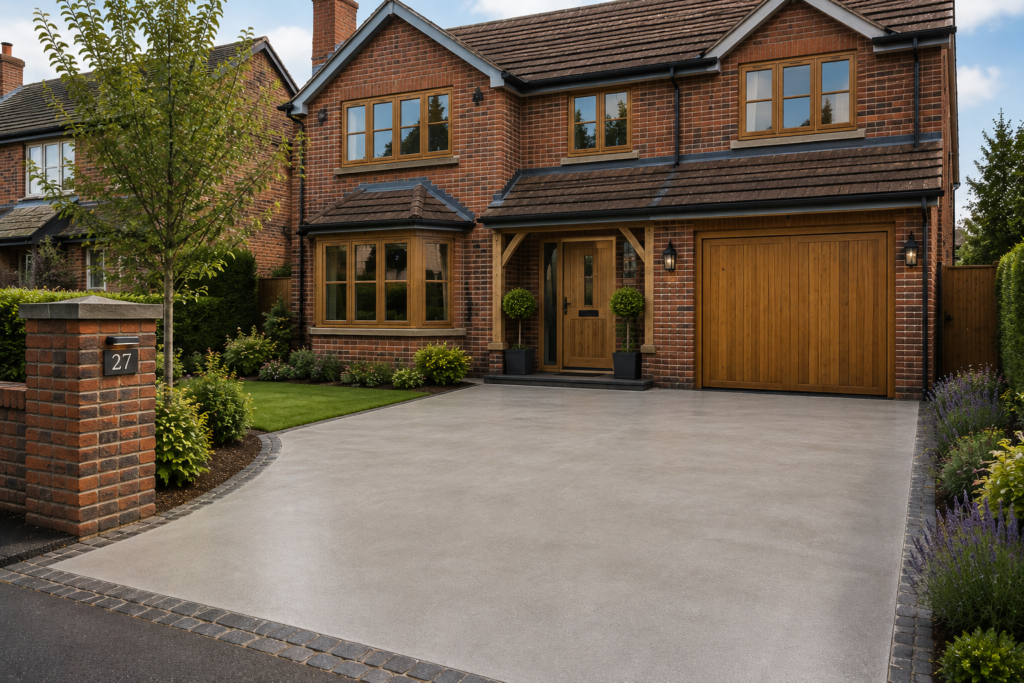
A standard concrete driveway uses a poured structural slab with a brushed, textured or decorative finish. It can be practical and durable when the ground preparation, slab design, drainage and movement joints are correctly specified.
- Strong continuous surface for regular vehicle use
- Plain, brushed, coloured and exposed-aggregate finishes are available
- Movement joints and drainage must be planned before the pour
- Localised repairs can remain visible after weathering
Construction and preparation
The formation is excavated to a suitable depth, weak material is removed and a compacted granular sub-base is installed. Levels, thresholds and drainage are set before concrete is delivered.
The quotation should state the intended slab thickness, concrete specification and any reinforcement or fibre system.
Joints and cracking
Concrete shrinks while curing and moves with temperature and ground conditions. Planned movement or control joints reduce random cracking, but no installer can responsibly promise that a slab will never crack.
Finishes and appearance
A brushed finish can improve grip, while exposed aggregate, colour and decorative borders change the appearance and price. Ask to view completed work because samples do not show the full effect across a large area.
Drainage and levels
Standard concrete is impermeable. Falls, channels and a lawful discharge route must be designed so water does not run onto the pavement, neighbouring land or the building.
Maintenance and repairs
Keep the surface clean, treat oil spills promptly and avoid aggressive de-icing products unless the installer confirms they are suitable. Repairs are possible, but matching colour and texture can be difficult.
Questions for the quotation
- What excavation, sub-base and slab thickness are included?
- What concrete strength and reinforcement are specified?
- Where will movement joints be positioned?
- How will water be drained?
- Which finish and curing method are included?
- What cracking and workmanship terms apply?
Concrete cost scenarios
These worked examples use the current concrete rate of £50 per m² and the same preparation and fixed-cost allowances used by the estimator. They are illustrative ranges, not contractor quotations.
Small single-car driveway
25m² · Minor local base preparation, straightforward access and no additional drainage work.
Standard two-car replacement
50m² · Existing tarmac removed, normal access, waste taken away and a drainage allowance included.
Large and more complex installation
80m² · Existing concrete removed, restricted access, waste and drainage allowances, plus a gentle slope.
Actual quotations can change after a site survey, specification choice, regional labour and supplier pricing, drainage design and ground-condition checks.
Peace of Mind from Estimate to Completion
Your Peace of Mind Project Tracker keeps the important stages, updates, photographs, documents and payments together, helping you understand what has happened and what comes next.
The material guide helps with the early decision. The accepted installer quotation and project specification remain the documents that define the work.
Estimate a concrete driveway
Enter the property, approximate area, existing surface and access details to receive an indicative price range.
Start an estimateCompare driveway costs