Block paving
Block paving uses individual concrete or clay units laid over a prepared sub-base and bedding layer. It is popular because the colour, shape, pattern and border details can be tailored to the property, while damaged areas can often be repaired without replacing the whole driveway.
- Wide choice of colours, sizes, patterns and contrasting borders
- Individual blocks can often be lifted and replaced
- Standard and fully permeable construction systems are available
- Quality depends heavily on excavation, compaction and edge restraint
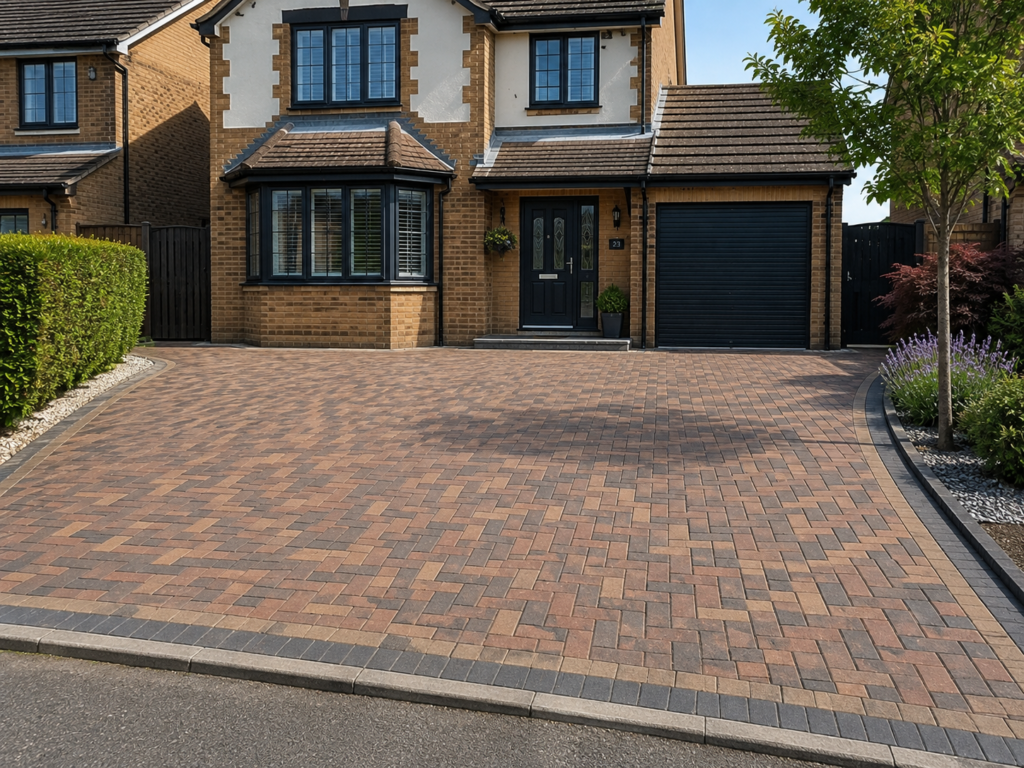
What block paving is
Block paving is a flexible paved surface made from individual concrete or clay blocks. The blocks are normally laid on a compacted sub-base, a screeded bedding layer and kiln-dried jointing sand. The finished surface is held together by interlock, jointing material and secure edge restraints.
Concrete blocks provide the broadest range of colours, textures and price points. Clay pavers usually cost more but can offer strong colour retention and a traditional appearance. The correct choice depends on the style of the property, expected vehicle use and the available budget.
Where it works well
Block paving suits small urban driveways, large parking areas, curved entrances and properties where borders or parking bays need to be clearly defined. It is also useful where access to underground services may be required because sections can be lifted and reinstated.
It may be less attractive to owners who want a completely seamless finish or very low routine maintenance. Shaded or damp sites can experience moss and algae, while poor joint maintenance can allow movement and weed growth.
What affects the price
The block product is only one part of the cost. Excavation depth, disposal, ground condition, drainage, area shape, cutting, steps, manhole covers and the number of borders all change the labour and material requirement.
A straightforward rectangular driveway using a standard concrete block is normally more efficient than a small irregular area with multiple colours, intricate circles and extensive cutting. Premium clay pavers, tumbled finishes and bespoke patterns can significantly increase the supplied-material cost.
Construction and sub-base
The existing surface and unsuitable ground should be removed to a depth that allows the complete construction to sit below the agreed finished level. The formation is assessed, soft areas are treated and a suitable granular sub-base is installed and compacted in layers.
A bedding layer is then screeded before the blocks are laid. Edge restraints must be secure because they prevent the paving from spreading under vehicle loads. Final compaction and jointing sand lock the blocks together. A visually neat surface can still fail early when these hidden stages are rushed.
Drainage and planning
Traditional block paving is generally impermeable, so the driveway must be laid to controlled falls that send water to an approved drainage point or permeable area. Channels may be required near garages, thresholds or the pavement boundary.
Permeable block paving uses specially designed blocks with larger joints and an open-graded sub-base that stores and disperses water. It is a complete drainage system rather than simply a different block. The installer should explain where water will go and whether local ground conditions support infiltration.
Design, patterns and borders
Herringbone is commonly used for trafficked areas because the pattern provides strong interlock. Stretcher bond, basketweave and modular layouts can create a different appearance but should still suit the expected vehicle movement.
Contrasting borders can frame the driveway, protect edges and identify parking spaces. Ask to see a realistic sample area because colours can look different in daylight and may vary between manufacturing batches.
Maintenance and repairs
Routine care normally includes sweeping, occasional cleaning and replacing jointing sand when it has been removed by weather or pressure washing. Sealing is optional and should only be carried out with a compatible product after the paving is clean and dry.
One advantage is repairability. Sunken, stained or damaged sections can often be lifted, the bedding corrected and the original or replacement blocks reinstated. Repairs are less visible when spare blocks from the original batch have been retained.
Common problems to avoid
Typical failures include rutting over weak ground, spreading edges, loose blocks, standing water, excessive settlement and loss of jointing sand. These are often linked to inadequate excavation, poor compaction, weak edge restraints or incorrect drainage levels.
Do not judge a quotation only by the block brand or price per square metre. Ask for the full construction specification, disposal allowance, drainage method and finished levels in writing.
Questions for the quotation
- Which manufacturer, block range, colour and thickness are included?
- What excavation and compacted sub-base depths are allowed for?
- How will edges, thresholds and manhole covers be finished?
- Where will surface water discharge?
- Are borders, drainage channels, waste disposal and VAT included?
- Will spare matching blocks be left for future repairs?
Block paving cost scenarios
These worked examples use the current block paving rate of £70 per m² and the same preparation and fixed-cost allowances used by the estimator. They are illustrative ranges, not contractor quotations.
Small single-car driveway
25m² · Minor local base preparation, straightforward access and no additional drainage work.
Standard two-car replacement
50m² · Existing tarmac removed, normal access, waste taken away and a drainage allowance included.
Large and more complex installation
80m² · Existing concrete removed, restricted access, waste and drainage allowances, plus a gentle slope.
Actual quotations can change after a site survey, specification choice, regional labour and supplier pricing, drainage design and ground-condition checks.
Peace of Mind from Estimate to Completion
Your Peace of Mind Project Tracker keeps the important stages, updates, photographs, documents and payments together, helping you understand what has happened and what comes next.
The material guide helps with the early decision. The accepted installer quotation and project specification remain the documents that define the work.
Estimate a block paving driveway
Enter the property, approximate area, existing surface and access details to receive an indicative price range.
Start an estimateCompare driveway costs