Natural stone
Natural stone setts and paving provide individual colour, texture and character. Because stone varies by geology and product, the installer must match the material dimensions, strength, bed, jointing and construction to driveway traffic.
- Distinctive appearance with natural colour variation
- Setts and suitable paving can provide a long-lasting surface
- Product strength and thickness vary significantly
- Correct bedding, jointing and sealing choices are essential
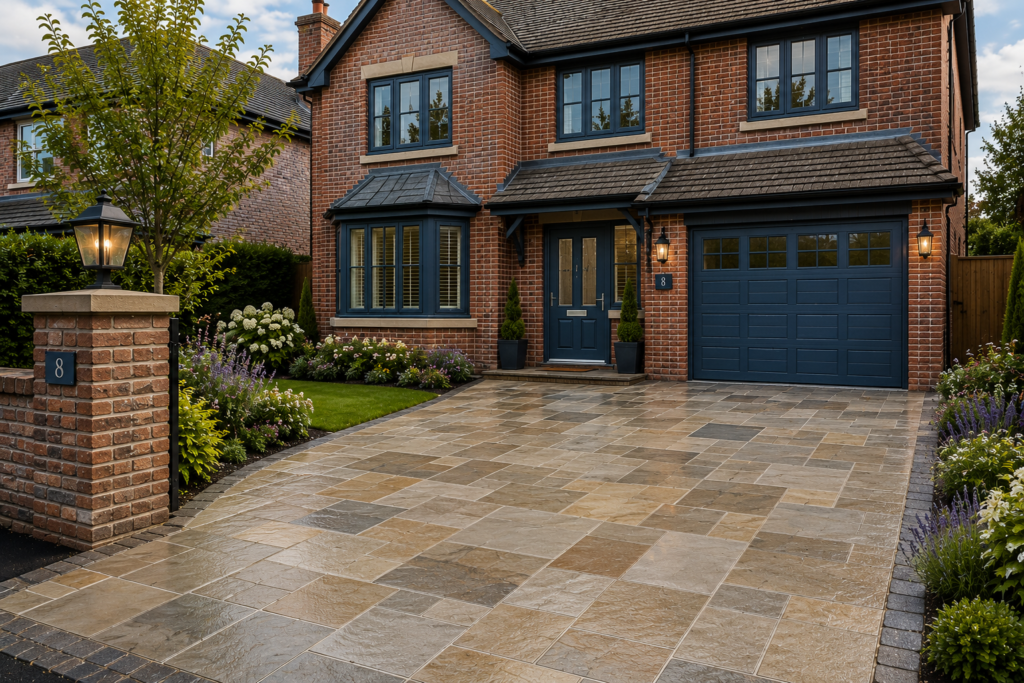
Stone choices
Granite, sandstone, limestone and other stones have different strength, porosity, texture and colour variation. Ask for the exact product name, origin, dimensions and declared suitability for vehicle use.
Setts versus slabs
Small setts distribute loads through many units and suit curves or traditional properties. Larger slabs create a calmer appearance but require suitable thickness, full support and careful movement detailing.
Base, bed and jointing
The construction should prevent settlement, rocking and joint failure. The bed and jointing material must be compatible with the stone, expected traffic, drainage approach and cleaning regime.
Colour, sealing and staining
Natural variation is part of the product. Sealing may reduce staining for some stones but can alter colour or breathability, so test areas and manufacturer guidance are important.
Maintenance and repairs
Clean with products suitable for the stone and avoid acids on sensitive materials. Individual units can often be replaced, although exact colour matching may become harder as the surface weathers.
Questions for the quotation
- Which exact stone, grade, size and thickness are included?
- Is it confirmed for driveway loading and UK weather?
- What sub-base, bed and jointing system are specified?
- Will the stone be sealed, and how will that affect appearance?
- Are spare matching units included?
Natural stone cost scenarios
These worked examples use the current natural stone rate of £120 per m² and the same preparation and fixed-cost allowances used by the estimator. They are illustrative ranges, not contractor quotations.
Small single-car driveway
25m² · Minor local base preparation, straightforward access and no additional drainage work.
Standard two-car replacement
50m² · Existing tarmac removed, normal access, waste taken away and a drainage allowance included.
Large and more complex installation
80m² · Existing concrete removed, restricted access, waste and drainage allowances, plus a gentle slope.
Actual quotations can change after a site survey, specification choice, regional labour and supplier pricing, drainage design and ground-condition checks.
Peace of Mind from Estimate to Completion
Your Peace of Mind Project Tracker keeps the important stages, updates, photographs, documents and payments together, helping you understand what has happened and what comes next.
The material guide helps with the early decision. The accepted installer quotation and project specification remain the documents that define the work.
Estimate a natural stone driveway
Enter the property, approximate area, existing surface and access details to receive an indicative price range.
Start an estimateCompare driveway costs